

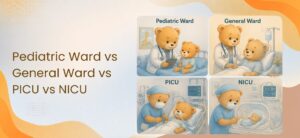
Pediatric Ward vs General Ward vs PICU vs NICU: When a child needs hospital admission, choosing the right level of care is critical. Hospitals offer different units based on severity, age, and medical needs. At Sparsh Children’s Hospital- Pediatric Hospital in Parel, care is divided into:

- General Ward: (Adults/General patients)
- Pediatric Ward: (Children with stable conditions)
- PICU: (Critically ill children)
- NICU: (Newborn intensive care)
Need Help Choosing the Right Care for Your Child? Speak to our pediatric experts for immediate guidance
Comparison – Understanding Hospital Care Levels for Children
1. General Ward

What it is:
A general ward is designed for adult patients or mixed medical cases who do not require specialized pediatric or intensive care.
Key Features:
- Shared or semi-private rooms
- Basic nursing care
- General physician supervision
- Limited pediatric specialization
Best suited for:
- Adults with mild to moderate illness
- Non-critical medical conditions
2. Pediatric Ward

What it is:
A dedicated inpatient unit for children who need monitoring and treatment but are not critically ill.
Key Features:
- Child-friendly environment
- Pediatricians available for daily rounds
- 24/7 nursing care
- Infection-controlled setup
Best suited for:
- Fever, infections, dehydration
- Respiratory illnesses like pneumonia
- Post-treatment observation
3. PICU – Pediatric Intensive Care Unit

What it is:
A high-dependency critical care unit for children who are seriously ill and need life-support systems.
Key Features:
- Mechanical ventilators & oxygen support
- Continuous multi-parameter monitoring
- Emergency life-saving interventions
- Highly trained pediatric intensivists
Best suited for:
- Severe infections or sepsis
- Respiratory failure
- Multi-organ dysfunction
- Post-surgical critical care
4. NICU – Neonatal Intensive Care Unit

What it is:
A specialized unit for newborn needs, requiring intensive medical care immediately after birth.
Key Features:
- Incubators for temperature control
- Neonatal ventilators & CPAP support
- Phototherapy for jaundice
- Continuous newborn monitoring
Best suited for:
- Premature babies
- Low birth weight infants
- Birth complications
- Neonatal infections or breathing issues
Emergency Admission Support Available 24/7 — Quick assistance for PICU/NICU admissions
Key Differences
| Unit | Age Group | Condition Severity | Type of Care |
|---|---|---|---|
| General Ward | Adults | Mild to moderate | Basic care |
| Pediatric Ward | Children | Mild to moderate | Pediatric monitoring |
| PICU | Children | Critical | Life support care |
| NICU | Newborns | Critical | Neonatal intensive care |
When Should Parents Choose Each Unit?
Choose Pediatric Ward when:
- Child is stable but needs admission
- Requires IV fluids or antibiotics
- Needs observation for fever or infection
Choose PICU when:
- Child has breathing difficulty
- Condition is life-threatening
- Requires ventilator or continuous monitoring
Choose NICU when:
- Newborn is premature or weak
- Baby needs incubator or oxygen support
- Complications after birth
Why This Classification Matters
Correct admission level ensures:
- Faster recovery
- Better monitoring
- Reduced complications
- Specialized treatment for each age group
- Improved survival outcomes in critical cases
Why Sparsh Children’s Hospital?
- Dedicated Pediatric & Neonatal specialists
- Advanced PICU and NICU infrastructure
- Child-friendly inpatient environment
- 24/7 emergency response system
- Integrated care from admission to recovery
FREQUENTLY ASKED QUESTIONS
1. What is the main difference between Pediatric Ward and PICU?
Pediatric ward is for stable children, while PICU is for critically ill children needing life support.
2. Is NICU only for premature babies?
No, NICU also treats newborns with infections, breathing issues, or birth complications.
3. Can a child be shifted from Pediatric Ward to PICU?
Yes, if the condition worsens, immediate escalation to PICU is done.
4. Is General Ward suitable for children?
Not always. Children ideally require a pediatric ward for specialized care.
5. How do doctors decide which unit is needed?
Based on age, severity, symptoms, and monitoring requirements.
Visit Sparsh Children’s Hospital, Parel — Get specialized pediatric care under one roof